...
This is one of those words that doesn't really sound like a word when you say it. Like you have to imagine you're saying it wrong. It's a simple thing, specifically just a lack of courage or confidence. This is something I definitely struggle with, and you can couple it with lots of other things: people pleasing, being everyone's friend, non-confrontational, yadda yadda... Ultimately though, and I'm thinking about this in the context of a workplace or leadership role, this is death.
That sounds aggressive, but I think it is true and something I'm trying to root out. If you find yourself saying something internally like, "Well, they all must understand better than me." or "I don't think I'm smart enough to comment on that." you need to stop that line of thinking. In reality, likely no one knows all the things. Terrifyingly, in many cases, YOU REALLY MAY BE THE SMARTEST ONE IN THE ROOM!
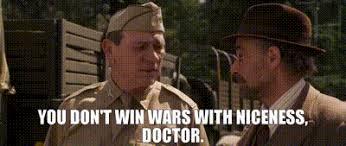
One of the things I think I do well is that I'm not afraid to ask ignorant questions. Oddly I'm not opposed to asking silly questions or looking naive because pretending to understand is a recipe for future disaster. However, it is difficult for me to call people out or question authority directly. Really I like being nice, but projects aren't always finished with niceness, and certainly wars aren't won that way (just ask Tommy Lee Jones).
The reason this has come up for me is that I've been reading a book called "The Victors"1 which is a historical account of WWII and specifically the work and leadership of Dwight D. Eisenhower. In his first foray into combat leadership, he let a particular general, who he had hesitancy about, stay in his role. The results were disastrous, but the lesson taught him that the ruthless removal of ineffective leaders has to come above everything else. Friendship, politics, "kindness", you'll see him on in the hallway...in his situation none of this can be part of the equation.
Now this is a very specific situation. Peoples' lives are on the line in combat, but there are corollaries I think exist in normal workday life, and it's something that I'm trying to adopt. Let's be clear though. Eisenhower is not saying that he was unaffected by the knowledge or relationships he had with individuals, but when it came to who he had leading, making strategic decisions, there was no room to play favorites. The other thing he realized, and maybe I'll write about this later, is that he focused on being optimistic. He quickly realized that optimism trickles down, as does pessimism, but even faster. So go out there and be positive and confident (even if you don't "feel" it) and you'll be surprised what can be achieved and the impact you'll make to others. I'm saying this to myself as much as the two other people who may ever read this.
Footnotes
-
"The VICTORS: Eisenhower and His Boys: The Men of World War II" by Stephen E. Ambrose ↩
